User testing
Accessibility testing
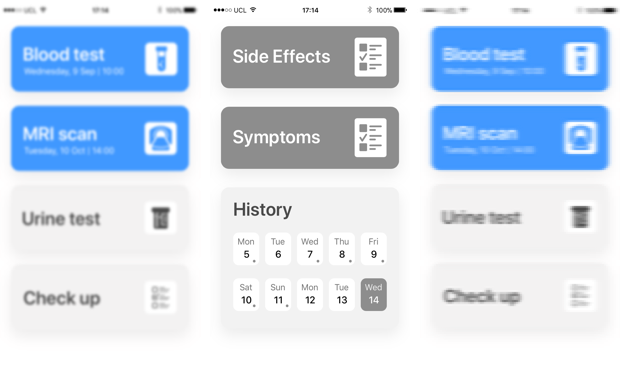
Before entering the real user testing stage, our team made internal tests for patients with blurred vision, any level of colour blindness and hand tremors.
We blurred all the screens within the app and changed the display to inverted colours or black-and-white. The result showed that, apart from extreme cases, the buttons and texts can be recognised to a large extent. We also tested the app recreating hand tremors. Since the buttons were large enough, no major barriers were encountered
User interaction
After that, we carried out two sets of user tests using the Thinking aloud technique [8]. The two users would see four questions, each with the same content but different ways of asking. We recorded what were they thinking while interacting with the prototype.
First user
- Set a blood test reminder.
- Record a blurred vision symptom.
- Check record history for the last seven days.
- Check record history for vision symptom in graph form.
Second user
Second user "What would you do if you..."
"have scheduled a blood test and you want to remember it?"
"wake up with blurred vision and you want to record it?"
"want to check your symptoms recorded previously?"
"want to see the vision symptom records more intuitively?"